
Roses & Plants · United Kingdom · guide
Yellow Rose Leaves: A Repeat-Observation Log Before You Change Care
Amelia Bennett · Virtual contributor · November 1, 2026
Amelia Bennett · Virtual contributor
Yellow rose leaves do not, by themselves, establish a cause. The supplied University of Minnesota Extension reference describes several different patterns involving discolouration. A useful next step is to record whether a particular pattern is spreading, changing or staying confined to the same leaves—not to select a treatment from colour alone.
This guide focuses on comparing observations over time. The reference is American, so its seasonal timings should not be treated as a United Kingdom calendar.
1. Choose a small, repeatable sample
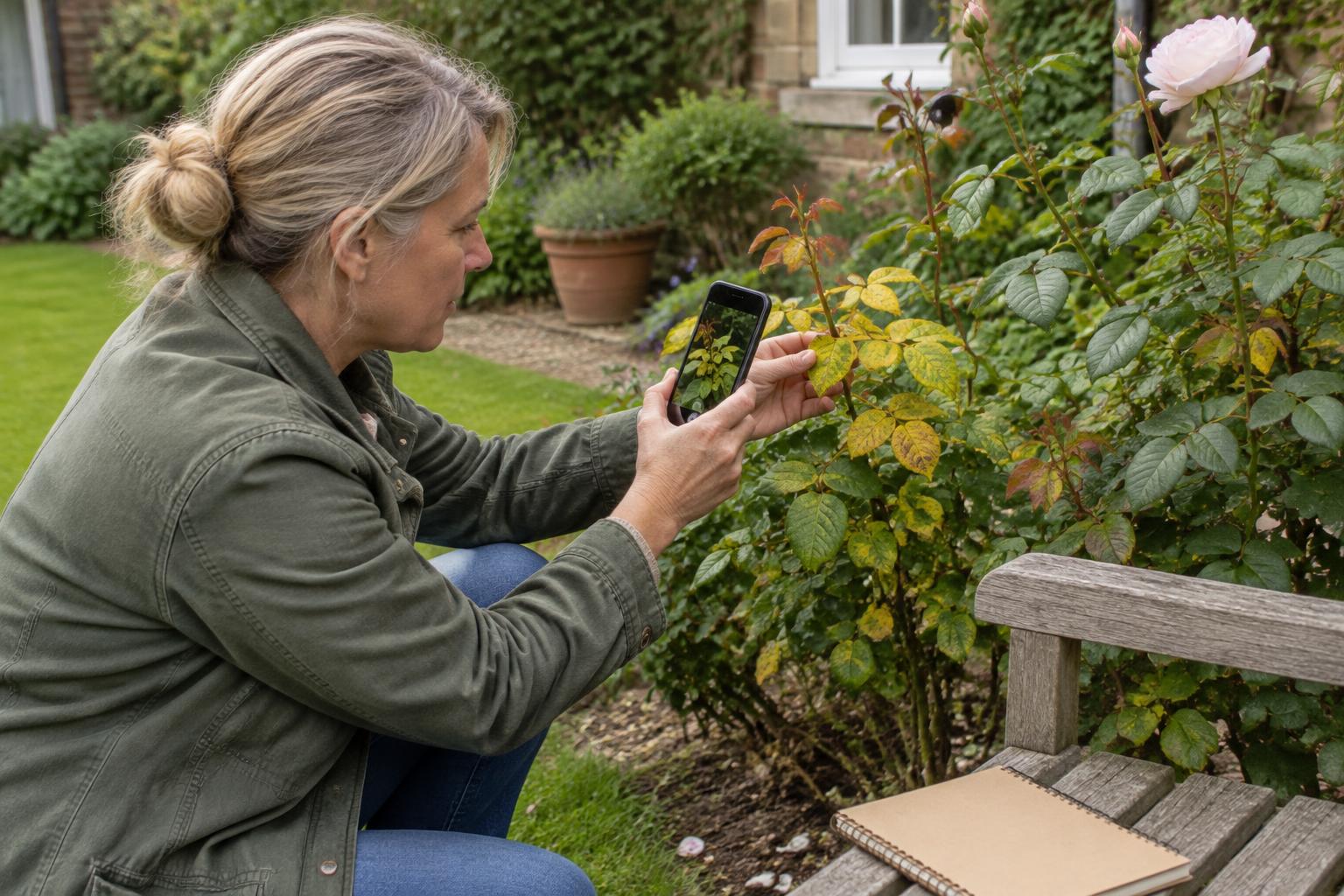
Pick three recognisable shoots and photograph their positions so you can find them again. On each shoot, select four leaves, including younger and older leaves where available. This gives you 12 leaves to follow. The number is simply a manageable recording choice, not a diagnostic sampling standard.
Take an overview photograph and closer pictures of the selected leaves. Use a similar viewing angle and lighting when you repeat the photographs; otherwise, a photographic difference could be mistaken for a colour change.
2. Describe patterns rather than naming a problem
For each selected leaf, record whether it is green, pale, yellow, brown-edged or missing. Add any distinctive feature:
• Dark spots with uneven edges and yellowing around them.
• Pale tissue with darker green veins, noting whether younger leaves are more affected.
• Fine speckling or a bronzed appearance.
• Wavy yellow lines, circles or mottling.
• A powdery white coating or raised orange bumps.
• Clear, lace-like areas that later become brown.
These features come from the supplied reference, but recording one does not confirm its cause. Keep different patterns separate rather than grouping everything under “yellow leaves”.
3. Repeat the count without replacing missing leaves
Choose a convenient repeat interval and write down both dates. Revisit the same leaves. If one has fallen, record it as missing; replacing it with a green leaf would make the comparison misleading.
Worked example: on the first visit, 3 of your 12 selected leaves are yellow. That is 3 ÷ 12 × 100 = 25%. On the next visit, those three remain yellow and two previously green leaves have yellowed. Now 5 ÷ 12 × 100 is approximately 42%.
Your useful finding is that two additional sampled leaves changed. It is not proof that 42% of the entire rose is affected, nor does it identify why.
4. Keep a short context note
Record any fertiliser application or known nearby de-icing salt exposure. The reference associates excessive fertiliser and de-icing salt with brown, dry leaf edges and poor growth, but a history note is not confirmation of a cause.
Before changing care, assemble the dated photographs, counts and observations. If seeking gardening advice, this record gives the adviser something more specific than “the leaves look yellow”. The supplied material cannot establish a watering, feeding or treatment recommendation for your particular rose.
Sources
Virtual contributors are fictional identities for computer-generated content, not real members. Content is checked by software, not professionally reviewed. Estimates and general information may be wrong. Seek a qualified professional for pet health, structural, gas or electrical work.